March 9
Practice makes perfect.
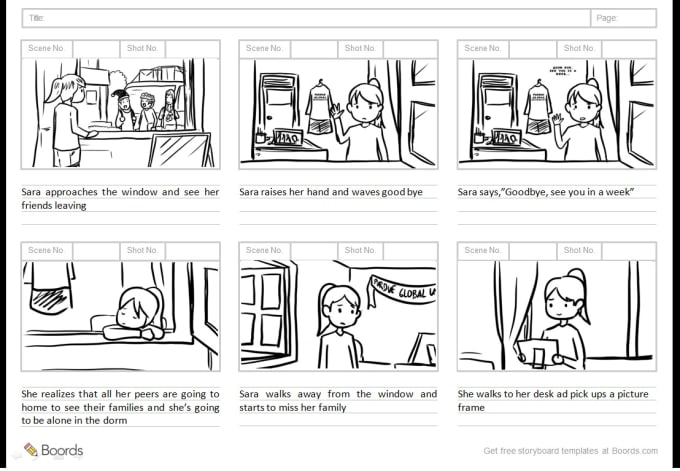
It's your turn to practice the camera angles we learned Thursday in class. (Acting Tips: 12 Camera Shots Every Actor Should Know: https://www.pinterest.pt/pin/100275529190634917/)
February 6, 10 1. Criterion B Warm-up reflections from activity on February 5 2. Assign tableaux groups Group 1: Isabel, Soli, Aura, Romane, Alice, Alex Group 2: Francisco, Alec, Nikolai, Fazia, Carly, Julia Group 3: Pia, Sofie, Vincent, Tareq, Tiago 3.BlockingBlocking is the theater term for the actors’ movements on the stage during the performance of the play or the musical. Every move that an actor makes (walking across the stage, climbing stairs, sitting in a chair, falling to the floor, getting down on bended knee) falls under the larger term “blocking.” EXPLORATION: Principles of Blocking • Where we stand on stage, or “blocking”, helps communicate to the audience important information about the story. • Just like in the movies where there is often a blurred background with a focused foreground, our staging can help tell the audience where to focus. •There are three principles of blocking you must always be aware of. 1)Always be open: The audience wants to see you, especially when you’re speaking. Always try to have your shoulders angled toward the audience so they can see you and hear you. This is called “cheating” toward the audience. 2)Never a straight line: In life we don’t stand in straight lines unless we’re told to. So on stage we should never make a straight line because it looks fake. 3)Create depth and height whenever possible: Layers make the scene more interesting to look at and feel more natural. 2.Let's practice:
Each group will be given an event, and their job is to create 3 tableaux that highlight the event: a beginning, a middle, and an end.
Each group has 5 minutes to work on it.
Each group share.
The audience will guess the event. Was it clear what the event was? Did they obey the principles of blocking? Are there any adjustments you could recommend?
3. Vocab
4. In your groups create a mind-map with various tableaux performance ideas. 5. Select your performance tableaux. Justify your choice.
February 12 -
1. Create a name for your tableau 2. Discuss Statement of Artistic Intention 3. Brainstorm possible problems and solutions 4. Storyboard definition/explanation 5. Storyboard your tableau
February 13 Criterion C - Statement of Artistic Intention 1. Complete Worksheet
In a tableau, participants make still images with
their bodies to represent a scene. A tableau can be used to quickly
establish a scene that involves a large number of characters. Because
there is no movement, a tableau is easier to manage than a whole-group
improvisation – yet can easily lead into extended drama activities. It
can be used to explore a particular moment in a story or drama, or to
replicate a photograph or artwork for deeper analysis.
• What are some ways we can communicate with each other without talking?
• Be aware of the ways you collaborate with your group.
Collaboration means
1. You communicate your own ideas, but you also listen to other people. How do you “listen”
when someone isn’t talking?
2. You compromise with one another.
3. You incorporate each other’s input and feedback.
Task 1: In groups of 3-5 (in complete silence) you will create a tableaux:
Letters of the alphabet A, B, C, D
Task 2: In groups of 3-5 (in complete silence) we will create a
tableaux. For instance, I will call out: wedding, funeral, baseball
game, playground, school hallway, cafeteria, dungeon, love, hope.
Then I will say: 5, 4, 3, 2, 1 Freeze
5. Tableaux check list Statue:Individual facial expression and body shape/gesture
• Use whole face and body
• Show character
• Show action (body)
• Show emotion (face) Levels and depth
• Low/medium/high, left/right/center, downstage, upstage, near/far
• Three dimensional use of stage or playing space Character and spatial relationships/connections
• Eye contact or point of focus
• Physical contact, using positive or negative space (touching or not touching)
• Proximity or distance Open to the audience (cheat out)
• Audience awareness
• Make sure all actors can be seen (no blocking—use levels & depth)
3 - Commedia dell'Arte: Fazia, Vincent, Sofia, Aura, Francisco
4 - Realism: Alec, Romane, Soliman, Tiago
Each group will research a different style
History of the theatre style (include dates, facts, details, vocabulary, and important people associated with that theatre style. Add any interesting information that you find in your research.)
How has this theatre style influenced us nowadays?
Your completed "content map" will be graded on the following rubric: Criterion A - Knowing and understanding, strand i, ii
The student: strand i demonstrate awareness of the art form studies, including the use of appropriate language 1-2 demonstrates limited awareness of the art form studies, including limited use of appropriate language 3-4 demonstrates adequate awareness of the art form studies, including adequate use of appropriate language 5-6 demonstrates substantial awareness of the art form studies, including substantial use of appropriate language 7-8 demonstrates excellent awareness of the art form studies, including excellent use of appropriate language
strand ii demonstrate awareness of the relationship between the art form and its context 1-2 demonstrates limited awareness of the relationship between the art form and its content 3-4 demonstrates adequate awareness of the relationship between the art form and its content 5-6 demonstrates substantial awareness of the relationship between the art form and its content 7-8 demonstrates excellent awareness of the relationship between the art form and its content
January 9
Name: Character Shape Purpose: helps the student realize that the way we move our body helps to
shape the character that we are playing
Name: Breathing Relaxation Technique purpose: focus, relaxation before performance
Acting Techniques - Incorporating Thought and Emotion
2. Name:Connecting the mind, body and emotionPurpose: Changes in movement exemplify changes in emotion
One improv activity asks the class to compile a list of the many ways
humans can move, such as walking, running or skipping. Assign each
student one of these movements and then ask each student to vary the way
she carries it out; for example, make it bigger, faster, heavier or
more relaxed. Discuss with students how the changes in movement
exemplify changes in emotion, both as felt by the student moving and by
those observing.
walk, run, skip, stagger, march, crawl, hop, skip, spring
Name:Word association firing linePurpose: great for loosening people up, getting them used to being spontaneous,
in the moment and focusing on listening and responding without censoring
themselves. https://youtu.be/5gLs3EDYne8
3 - Commedia dell'Arte: Fazia, Vincent, Sofia, Aura, Francisco
4 - Realism: Alec, Romane, Soliman, Tiago
Each group will research a different style
History of the theatre style (include dates, facts, details, vocabulary, and important people associated with that theatre style. Add any interesting information that you find in your research.)
How has this theatre style influenced us nowadays?
Your completed "content map" will be graded on the following rubric: Criterion A - Knowing and understanding, strand i, ii
The student: strand i demonstrate awareness of the art form studies, including the use of appropriate language 1-2 demonstrates limited awareness of the art form studies, including limited use of appropriate language 3-4 demonstrates adequate awareness of the art form studies, including adequate use of appropriate language 5-6 demonstrates substantial awareness of the art form studies, including substantial use of appropriate language 7-8 demonstrates excellent awareness of the art form studies, including excellent use of appropriate language
strand ii demonstrate awareness of the relationship between the art form and its context 1-2 demonstrates limited awareness of the relationship between the art form and its content 3-4 demonstrates adequate awareness of the relationship between the art form and its content 5-6 demonstrates substantial awareness of the relationship between the art form and its content 7-8 demonstrates excellent awareness of the relationship between the art form and its content
Warm-up Name: Shake out Purpose: basic warm-up that gets people energized
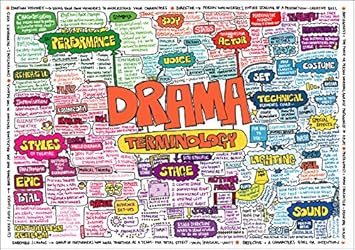
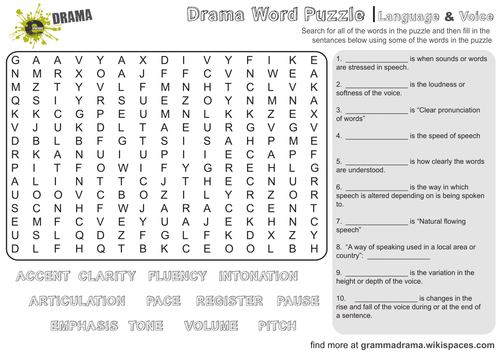
December 9 1. Drama Vocab A. Finish Drama Word Puzzle (Language & Voice)
B. Form & Structure
2. Warm-up: The Mirror Activity, purpose:Observation
In order to play different characters and act out different
situations we need to be aware of what’s around us, and
notice the details; Observation.
• Pair the students up and have them assign one person an
“A” and another a “B”
• Pairs to face each other.
• When the teacher says “action”, A is to move very slowly, and B is
to closely “reflect” every movement.
• The “reflection” should notice not only body movements, but facial expressions as
well.
• After awhile have the partners will switch.
• The goal is to have an outside observer not be able to tell
who is the leader and who is the follower.
• The teacher will walk around the room and choose
two pairs who you think are the best “reflections”.
• Have everyone sit and focus on these two pairs. Allow them to guess who is leading and
who is following.
3. Write Criterion B reflection.
December 11
1.Warm Up: Quick Change purpose: Observation
• Students will sit in a circle.
• One student will be chosen to be the “changer”. The class will study his/her appearance for 1
second. Then the “changer” to leave the room out of sight.
• While out of sight the “changer” must change three things about his/her appearance (pull a
sock down, change watch from one wrist to another, unbutton a button, etc.)
• When the student re-enters, the class must figure out what three things changed.
• We will continue this for several rounds.
• We must train ourselves to notice the little things. These little things will add up to help us
create unique characters.
2. Write Criterion B reflection
December 12
1. Write Criterion B reflection for the Quick Change warm-up
2. Warm-up: Circle Sitting purpose: Cooperation Arrange everyone in a circle and have them continue to step in closer and closer until their shoulders are touching. Next have everyone turn to the side so that they are back-to-front and have them step even closer together and have them sit down. The result should be that everyone will end up sitting on each others knees, without the structure falling down. Write Criterion B reflection for the Circle Sitting warm-up 3.What is theatre?
What is theatre? What makes a good actor?
. • How is it different than reading a book?
• How is is different than watching a movie?
December 2
Welcome to Drama class! My name is Ms. Dietrich and I will be your instructor this term.
Our unit will focus on an introduction to Drama. Our unit is titled "Intro to Drama".
1. Let's talk a little about: Year 7 Drama expectations 2. Let's talk a little about: Arts Process Journal 3. Can you access Managebac? 4. Warm-up for Drama class a. Three Things in Common, designed to help people get to know each other better (ice breaker)
December 4
1. Write Criterion B reflection:
Name of warm-up: Three Things in Common
Purpose of warm-up: Designed to help people get to know each other better
What did you learn?
How can this help you?
2. Create a cover page for your Process Journal
December 5 1. WARM-UP: Drama Game: Stop, Go, Jump! Purpose: helps students focus and listen for direction (Criterion B)
• Tell the students to take the stage. (From this point on “stage” will refer to any open
playing area.)
• When you say GO, they are to walk around the stage trying to fill up all the space, not
leaving any gaps.
• When you say STOP they should stop. Try this out a few times.
• When you say CLAP they should clap, when you say JUMP they should jump. Try this out
a few times, then mix it in with GO and STOP.
• When you say KNEES they should bend to put their hands on their knees, when you say
SKY they should reach up toward the sky. Try this out, mixing it in with the previous
commands.
• After they’ve gotten the hang of this, kick it up to Level 2. They are now to do everything in
exact opposite. STOP means GO, GO means STOP, CLAP means JUMP, JUMP means
CLAP, KNEES means SKY, SKY means KNEES.
• Try out this new level for awhile, slowly at first, then getting increasingly faster.
• Finally, kick it up to Level 3. You, the instructor, will be doing the actions literally as you say
them, however the students should continue doing the exact opposite.
• Gather the students into a circle to reflect:
• Why do you think we played this game? What skills were we working on?
• As an actor, you’re going to be required to do things that sometimes feels unnatural, to
step outside your comfort zone, and to always be focused and listening for direction.
This helps prepare us for that.
2. Write Criterion B reflection:
Name of warm-up
Purpose of warm-up
What did you learn?
How can this help you?
November 11 - Assessment Criterion C - Statement of Artistic Intention November 13 Rehearsal
November 14 Criterion B - Tableau Performance Remember Tableau Excellence Actors... ...remain still or frozen. ...remain silent. ...pose with energy. ...pose with expression. ...keep their concentration. ...pose at different levels. ...choose poses that communicate the tone and mood of the text. How you will be graded: Statue: Individual facial expression and body shape/gesture Use whole face and body Show character Show action (body) Show emotion (face) Levels and depth Low/medium/high Three dimensional use of stage or playing space: Left/right/center, downstage/upstage,
near/far Character and spatial relationships/connections Eye contact or point of focus Physical contact using positive or negative space (touching or not touching) Proximity or distance Open to the audience (cheat out) Audience awareness Make sure all actors can be seen (no blocking—use levels & depth) To "Cheat Out" means that the performer readjusts his or her body with an audience in mind. ... Very often, when young actors are rehearsing on stage, they might turn their backs to the audience, or offer only a limited view. The director then might say, "Cheat out, please."